Tuesday, March 31, 2015

Mind your fingers....

I think I drive most sewers crazy. Mostly because when they see me sew I don’t use a thimble. Part of the reason why is my finger gets too hot, the thimble gets in my way and I have trouble finding ones I like. I have a few, plastic, metal, all covering, tip covered, band, but all come off after about a minute. I just don’t like them, if I have been sewing most of the day or am working with really tough fabric I will use them but over all I find them a nuisance.


It is hard to date when the first thimbles or “thymel” came into use but they have been around for centuries. Some thimbles were bands and evidence of them has been found at Vesuvius in Italy, though are known to be much older than that. They were more for courser materials when you had to push the needle with the side of your finger rather than the tip. The ones that covered the whole tip of your finger were more common among housewives and were widely in use by the 14th century (1300s).


During the Renaissance period pewter was one of the most common metals for making thimbles. Most were hand struck with small dimples along them hand punched. They also could have been cast. They were/are decorated with designs such as flowers, dogs chasing boars, and trees they were something every housewife had in their sewing basket. Some wives even had cases to put them in. Today they are as much a collector’s item as a useful tool.


So here is to protecting our fingers, or not as the case maybe.


Tuesday, March 24, 2015

Sewing with Ryan.....

This is a guest post from Ryan O'Connell at http://ryansinterp.blogspot.com/ an old friend of mine from my days in the park service. 

Hello! As a brief introduction to what I do at my own blog, I write about historical interpretation; my thoughts, it's meanings for my life, and for understanding our past publicly. One of my hobbies is Civil War Living History, commonly referred to as “reenacting”. As a Living Historian, it is generally up to me to come up with my own impression. An impression is a role I play expressed through appropriate clothing and equipment in order to tell about the time period which I am representing. Since this is generally a blog about clothing and sewing, I thought it would be appropriate to share a sewing adventure I recently had.  


Three years ago my drawers gave out. Drawers are what modern contemporary people might identify as long underwear. I will not go into details as to how they gave out, but let us just say I needed a new one. This last one was made from canton flannel, which is an appropriate time period fabric for these articles of clothing. Canton flannel is cotton flannel that is napped only on one side of the fabric, the fuzzy side in, and are very warm. I asked my wife to make me a new pair, so she got the flannel and she was going to make them for me.


Two years passed and other projects came and went.


I recently moved to Iowa with my wife, where it gets cold and I needed another layer under my clothing and she remembered to bring the canton flannel along. So, since we had a lot of time on our hands and I was interested in helping, we both set out to make me a new pair of drawers. We used Past Patterns “Middle to Late 19th Century Gentlemen's Drawers” and modified it to have draw-string waist and ankles. My wife had made a muslin version previously and she had kept all the tissue patterns from that set and applied them to the fabric and we began cutting. She told me to keep the pattern pieces in line with the grain of the fabric and mark the pattern pieces. She handled most of the tricky parts for me since I am very new to sewing. I had put buttons on before, but making a piece of clothing was daunting to me.

Wednesday, March 18, 2015

Mind your needles

I understand the meaning of is "sitting on pins and needles". I mean I have on more then one occasion sat and stepped on a number of pins and needles. The secret all sewers and crafters know though is tools disappear, and usually at the most inconvenient moments. Sometimes we never find the tool again. I have lost Lord knows how many knitting needles, (and only ever just one), then there are the scissors, rulers and whatever was just in my hands. Yea half the time whatever we just lost was literally just being used. It is almost like a disease. Yet when we lose pins and needles it actually hurts when we find them.

This is not such a big deal today when needles and pins go missing they are relatively cheep to replace. Yet small and very thin in nature they were once very hard to make and the materials rare, and that made them very expensive. This means you held on to and took care of the ones you had.  There were/are of course pin cushions,  but they really are that, pin cushions. Even sewing pillows were awkward for holding pins.  Two things happen when you put needles in,  the first they fall out, the second they go in. If it is the first then you may have lost the needle forever. If the second you pray it doesn't come out the other side. I have gotten myself on more than one occasion with the reappearing needle.  (This is why you stay up to date on your tetanus shots.) To avoid this you can leave thread in the eye of the needle,  but it might fall out, or get snagged and you end up dragging it across the house. You can weave it in and out of your cushion and hope you don't accidentally stab yourself when you reach for a pin. The best solution I have found though is a needle case.

My personal needle cases. The wooden one for historic demonstrations and the other one for my own personal use. 

Needle cases have been in use for centuries. The earliest versions found appear among st Viking digs. Use to protect the small tool, they tend to be small hollow tubs with a lid. During the Victorian Era they took on a decorative quality often hanging from the housewife's waist ready for when she needed it. Though housewives had been hanging things from their waist for centuries the Victorians made an art of it.


So whether you stick your needles with your pins, keep them in the book they came in, put them in a bit of cloth or use a needle case, mind your pins and needles,  or at least be thankful they are cheaper now and stay up to date on your shots.

Tuesday, March 10, 2015

In my basket...

Here I sit with my legs curled up
Besided me tea steams from my cup
On the floor my basket sits open wide
I have it filled for projects I mind
Knitting, sewing, and tatting too
I always want to make something new


They are made of cloth, wood and straw as well
It has needles, scissors, thread and more to tell
All these make for creative mind
In it there are no limits for what I can find
The world is my oyster for what I can make
And make it I shall, for my sanities sake


So what's in your basket?
What will create?
The world yours to  make?
Or shall you forsake?


Tuesday, March 3, 2015

This is my temporary home...

So in December my roommates and I decided to leave our two bedroom apartment. My move was going to be bit on the big end. I am moving into a two bedroom, two bath trailer about 15 minutes down the highway. This will be my third move in 3 years, and hopefully my last for the next five to ten years as I purchased said home. In 2013 I moved back from WV and lived in my parent's Airstream at 2 different campgrounds near where I worked. Last year though I contacted a co-worker and his girlfriend and we found a place together. It has proven to be an excellent stepping stone.

Now I have spent the last three months making this move possible. Thankfully it came to pass because there are no letters after Z. I have crossed my Ts and dotted my I s, prayed to God that it would all work out and thanked my family for standing beside me when I told them my plan and then proceed to be hit with every roadblock possible. Once everything was okay,  all parties were happy there wasn't much left to do but to spend my last two days before the official signing, packing.

Immigrants arriving at Ellis Island.


Every ones dread, packing.  For nomads in our early history easy enough. They were used to it, and they needed  it to survive.  I am sure it didn't make them hate the idea any less but they had to. We all do in the end. It is part of growing up. My work husband pointed it out to visitors this summer in the best possible way though. "Why does anyone ever want to move but to make their lives better." Women move in with their men to not only be with the man they love but to secure a future in a threatening world. Even today couples move in with each other to protect each other. Children move out of their parent house to strike out on their own to better their lives, to secure an unsure future. We move to be closer to family, to have help when we need it. Then we move to get away from family because they are too involved. Every time we pack up and move on we hope and pray it is for the best. Sometimes we are wrong but sometimes it is the best thing. It gives us strength, it shows our courage and makes us wonder if we are sane. Bonus point today is we don't have to cross on a ship to move.


So as my belongs steadily moved to the packed corner and the day got closer. I count my blessings and thank the heavens above things seemed to workout. Here is to the future,  may the past make me strong enough for it.

Tuesday, February 24, 2015

The Good, the bad, the ugly and the dribble...

Forgive me while I climb up on my soap box.

Oklahoma is trying to get rid of it's A.P. History program and it isn't the only state. One of the reasons stated is "it omits American Exceptionalism" and "focus on the negative". If that is truly the reason either they didn't listen in their history classes or they should get rid of history in school altogether.  If it is the former I pity their teachers and our forefathers.  If it is the later, I weep for the future.

Now history can teach us, it can entertain us and it can destroy us. By studying history Secretary of State William Seward saw that the U.S needed to attain the Hawaiian Islands,  Midway Island, Guam, as much of the Philippines as possible and Alaska. He was laughed at. In fact Alaska, his big purchase from Russia, was called Seward's Folly. His reason for why He U.S. should acquire all these places was to protect the States from Russia,  Japan and China in the event of a war. Alaska, with the discovery of Gold paid for itself before it was even officially purchased.  That was in the 1860s.


It can entertain us by just reading it. It may not seem it but stories like the Odyssey by Homer, fairy tales by the Grimm brothers or Hans Christen Anderson, or The Canterbury Tales by Chaucer tell us about the culture and the fears and hopes of the people.  The Odyssey tells us about the Greek social system and what was expected of families at the time. The fairy tales tell us of a changing social world. Where scullery maids could become princesses and a dark world was expected for all who didn't listen to their parents. Chaucer gives as one of the rarest looks into social classes in Medieval England. In fact not much is known about 130Os beyond the Kings and Lords of England without his glimpse into a very dirty minded lower class view of the world.
the Subjects of the Canterbury Tales

Yet in the right/wrong hands history can and has been used to support ill gains. Hitler, Lenin, Hussein, Napoleon, and Cesar all studied their predecessors to learn how to best bend and keep the people in their power. Some were better than others. Slave holders throughout time used it to justify the act. Men have used it to suppress women and women to control men. It has been used to justify war, to support violence, and too put one human over another.
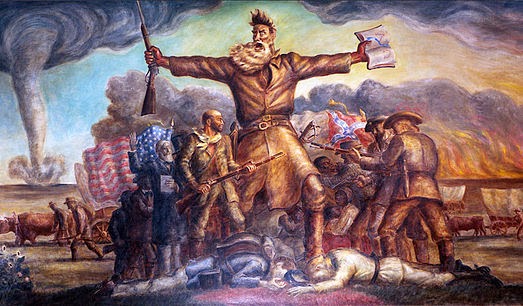
John Brown and the War against Slavery. the original is in the Kansas State House but a copy resides were John Brown made his finial stand, Harpers Ferry, WV.

When we teach it we should not omit it, not one part, because when we do we succumb to the dark ages once more. History will never be simple, never be easy, and that is because humans aren't. We have killed and suppressed each other, we have led with heavy hearts and yet we are still here. We are still learning and still growing and without telling the good, the bad, the ugly, and the useless dribble that can't continue. So yes America is amazing but we aren't perfect, and we still have aways to go and so does the rest of the world.

Tuesday, February 17, 2015

Purple Thang

At a sewing show I came across a magical tool for $5. I had seen it in quilt stores once or twice before and thought... "what a waste of money". I was wrong, so, so wrong. Here is the thing when it comes to life we are always looking for ways to make our lives easier. It is why we have everything in our lives. Now this tool I have used to fold seams, iron seams,  push difficult cloth through my machines foot and feed dogs, pull elastic through the band and a few other tasks. A simple tool but it works and I don't have to worry that I might accidentally melt it with the iron.

Tuesday, February 10, 2015

Baker gonna bake

So last summer I learned how to bake bread. I even got an assistant baker job at my day job. This resulted with me spending the next two months practicing in my tiny oven in my apartment on my one good  counter space. I used one recipe just to practice the main kneading method we would be using in the bakery called folding. it called for a dutch oven to bake it in. I called my mom and she had a dark glass one I could use.

Unfortunately it broke a few weeks ago. I did briefly think about buying a new one but while home for Christmas I used my moms baking stone. This helped me decided I would rather have a baking stone. After I did some research I bought a 15" pizza stone from Hartstone. Not only was it made in the USA but also under $30 so my wallet also did a happy dance.
No knead bread just coming out of the oven.

Now I have used it a couple of times and I am in love. Now all bread used to be made in brick/stone ovens, sometimes called beehive ovens. They would typically be in a dome shape with b a small opening in the front. A fire would be set inside for an hour or more heating the oven. Once the ashes are cleaned out the operator (baker, baker's assistant,  housewife) would stick their hand in. For me 5 to 8 seconds is about 450° to 500° Fahrenheit which is what most bread recipes call for. If I can hold my hand in that long it is good to go. Now this method goes back as far as risen loaves.

Bread going into a stone oven. The woman is using a peal to insert the bread. 14th century


The idea of a baking stone, which a lot of people use for pizza, goes back to that idea. The dutch oven is supposed to give it the seal an original stone oven would but the stone helps with even out the heat. It also has shortened my cooking time down from 30 to 40 minutes to 15 to 20.

3 century B.C. Roman mosaic Note the pipe in the back, most likely the baker keeps a small fire going in the back or on the side while he is baking.

So here's to the old ways and fresh bread.


Recipe used: No Knead bread from motherearthnews.com