Tuesday, October 27, 2015

Cable me up


Probably one of the most iconic types of knitting is Aran knitting. Beautiful, less complicated than it looks and memorable. The term Aran itself denotes the three Aran Islands in Galway Bay, Inishmore (once known as Aranmor), Inishmaan and Inisheer but also the beautiful knitted cable worked sweaters that have become so iconic to time. However as far as knitting techniques go it is rather new. Developed with in the last 100 years it has become a very iconic knitting idea very quickly.


Sweater I made last year with Celtic knot cables on the wrist and front.


By simple twisting of the stitches beautiful cables can be formed. Using a small double pointed and often curved needle you move the stiches behind or in front of the knitted stiches. By doing this you create an amazing cabled stitch and what we today call Aran knitting. Each design could be combined with others to create amazing art that you can wear.

Socks J made last year with simple cables on the top.


It is because of these beautiful combinations a piece can be like no other piece. Hand knitting is always defined because each piece is different, beyond the needles and the yarn, just by moving the needles every piece made is different from the last one, even by using doing it exactly the same from project to project. How knitting works is as you work you make something unique to you with mistakes, messed up tensions, ladders. Some of those things will fix themselves over time but even if they don’t that is ok. Knitting is for life, and Aran I think proves that. Created to make one of a kind pieces that unfortunately may sometimes have been used to identify fisherman lost at sea. Some had flaws but what are flaws when you are venturing out to some new.


Y cable ear warmers audible for sale or my etsy page: GrandmasTools.


I was afraid to try cabling the first few times I did it. It was an adventure but by learning it I would eventually be able to create beautiful pieces that are one of a kind to me. Still working on trying to create one that is just by me but I will get there.

Celtic knot Cable hat going up for sale on my etsy page November 1st. GrandmasTools

Tuesday, October 20, 2015

High Cotton

We have all seen the commercials, and we all know the jingle. “The touch, the feel of cotton, the fabric of our lives.” A pretty common material today thanks to the invention of the Cotton Gin in the 1793 by Eli Whitney, it wasn’t always cheap or available. Been cultivated for at least the last 7,000 years it has helped shape cultures, save and ruin lives and cloth the backs of men.


In 3,000 B.C it was being cultivated in Pakistan and being spun and woven into cloth. By 800 A.D. it was brought into Europe by Arab Merchants.  By the time of Columbus’s adventure to the new World in 1492 where he found it on islands in the Bahama’s it was well known through most of the world. The Industrial Revolution, the Cotton Gin and sadly the building of the slave trade made the south the King of Cotton by the 1800s. It became more available to the masses, and came in a variety of colors and eventually would be dyed with little flowers on them. Something that was extremely expensive in the 1700s soon would become extremely cheap and the most common cloth in a just a few years. Within 10 years it grew from a $150,000 industry to $8 million.


This fluffy little seed is what everyone wanted, once cleaned of the actual seeds the fluff, could be spun and woven. Between the fact it is hard to clean it of the seed by hand, has a very short staple length which makes it very hard to spin by hand and easy to break, which is probably why it took so long to become the common cloth of the world. The cotton gin made it easier to clean but back fired from making the slaves lives easier to harder as the cotton industry to grew. That and the demand for cheap cloth, and the mechanized world of the cloth industry made the south the King of Cotton.

Eli Whitney's cotton gin


So the touch and the feel of cotton has come with its price. Whether it is the expense of coin or the expense of man, history has made it a lasting and renewable cloth. The world of natural fiber, older than anything we can ever imagine.

Tuesday, October 13, 2015

What is the point?

I am often asked why, what is the point? I am always asked these questions when I am sewing, knitting, and spinning. I have been asked why I do “old people” hobbies? (A question I find insulting and to you I say phewy). Yes I know I can buy clothing at Walmart (I refuse to even step in that store if I can help it). Yes I know it would be easier if I just bought the clothing but I like creating something for myself. Also I find it away to spend my time wisely I have stated before I keep knitting in my bag so I can work on things when I am in other places, my space in my living room is surrounded by the tools of my trades and it is wonderful seeing the art take shape and become something no one else can make.
KNITTING pinback BUY SOCKS FOR 2 BUCKS button badge - 1.5 inch pin:


Most recently I was spinning in public and a little boy and his mother stopped to watch and I explained how the tuff of wool I was holding was becoming a think yarn. He watched for a minute and then asked “What is the point?” I stopped my spinning wheel and looked at him, and after repeating his question, I smiled and said “You are wearing the point. Everything you are wearing was spun, by machine but before those machines all material was spun by hand on a spinning wheel or drop spindle. It was then taken and woven into cloth. That cloth can be made into your pants, your sweatshirt, or it was knitted like your t-shirt, your socks and the cuffs of your sweatshirt. Today it is all done by massive machines in factories but before the 1800s Industrial Revolution it all had to be done by hand.” I showed him spinning on the drop spindle, knitting a sock I was working on and showed him my sewing basket.

Irish women carrying 30 kilos of peat and knitting at the same time. Gaelic multitasking at its finest.
Women in Ireland carrying 30 kilos of peat on their back while knitting. Multi tasking at it's finest.


You see everyone is wearing the past, present and the future. I know it odd to think about but the magic that is making something from scratch can be fascinating. The number of people who just sit and watch whenever I am working, who ask me questions and who say it is like magic. That is our history, everyday life to someone hundreds of years ago. What comes out can be complete magic as a tuff of wool becomes yarn and that ball of yarn becomes a hat, socks or a sweater. Or it gets woven and becomes shirts, handkerchiefs, pants and so much more. So what is the point? I guess it depends on the Artisian you are asking.  Plus what else am I going to do at the doctor's office or while watching documentaries on vikings or the Big Bang Theory.

My yarn and I are very similar...as it begins to unwind, I do too. :):
from http://blog.redheart.com/donnas-dozen-hats-off/

Tuesday, October 6, 2015

Tracking the untrackable

What a world we live in… all the information we could ever want at our finger tips. Every day more and more is uploaded onto the internet. Some of it is way more then we want to know, other bits are just not interesting and some of it well some of it we spend hours and hours looking at studying and following the mystical trail that seems to lead nowhere. Oh and the latter is usually us looking up something we meant to and we ended up watching cat and music videos only to realized we just spent 6 hours not researching what we meant to do.

Oh I spend plenty of time looking up what I want to but can I also say it is really hard when either the source I am looking for has not been uploaded yet, destroyed by time, destroyed by war, destroyed by vandals, in a language I can’t read, or my favorite it was never talked about in the first place. The thought that any history has been lost to time has always been sad, the idea that it was damaged by vandals, war or people who just don’t care is painful but the idea that they never wrote about it is frustrating.


Here is the thing, I want you to look at your own life, think about what you have written about, read about, and talked about in just the last year. Now I want you to think about if you could meet me what would you tell me about your life. Now it would probably the highlights, the craziest things you have ever done, the funniest thing that ever happened to you, the things that we have in common and whatever new is happening to you. Now think about what you won’t be telling me about, a trip to the grocery store, when you went to the bathroom, and so many other information that you and I both can assume I know and probably don’t want to talk about. It is the same thing with history. What we read, what we see and what comes to life are the strange and new things people have decided to share. It is why history is written by the Kings, Queens, and the winners.
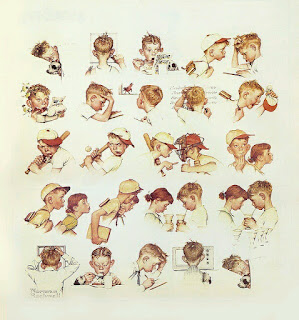
Day in the life of a boy by Norman Rockwell


As historians we are getting better at piecing together information of the everyday lives of everyday people through out time. How do we piece together information that is not there? We do experimental archaeology. That means we try things out and we use logic. When it comes to everyday life we can start by looking at basic necessities, housing, food, clothing, drink, and health. Between archaeology and what paintings, books, documents and drawings we do have we can start to date things. That is where we can begin and then we just have to use a little common sense and hope more things come to light. I think just because there is no evidence of something that doesn’t mean that it isn’t possible if common sense pulls you in that direction. There is written evidence of places there are no physical evidences of until they are dug up. There is physical evidence of things that there is no written evidence of. When common sense says people will use whatever is available to survive so even if there is no evidence of a shelter we can assume there was some form. We know that people eat and although there may not always be evidence of food at a dig site, there is signs of cooking, and signs of what their diet may be by the teeth and chemicals from bodies found on sites. We know people were wearing clothing and although that is some of the first things to decompose we automatically know they dressed
themselves because there is evidence in other cultures. Now we just have to look at what may have been available to them to explain what they were wearing.
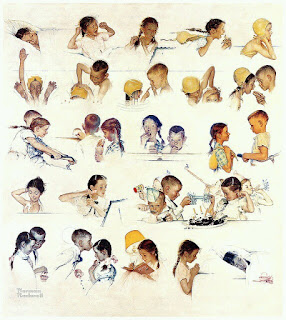

Day in the life of a girl by Norman Rockwell


So here is to frustrating history and searching out the truth.

Tuesday, September 29, 2015

Chalk it up

Alright one of the most useful tools in a seamstress’s arsenal, (and one of the least likely to work) is sewers chalk. There are a few varieties which you can by, all with their uses.

The first is paper, and wheel. Only been around at least since the 1950s (I have some of my grandma’s I can date to around then) it is used to transfer patterns on to cloth. It can help you mark where darts are or where sleeves are to be placed. This of course only works if you remember to make the marks before you remove you pattern. The paper only works though if you have a spiked wheel that you run over the pattern to transfer the chalk.


Then there is actual tailors chalk, commonly found and sometimes useless. I have had many that just would not mark well. Usually in a block/square form they tend to come in three colors, white, blue and yellow. This is the oldest version.


Next you have one I came across a few years ago and it is the one I use most often. It is a refillable pen made by clover, you fill it with the chalk color you need, (yellow, blue or white) and then little nibs that roll transfer whatever you are drawing on to the
cloth.


Of course there are also pencils.  Simple, cheap and look like this.


The other one I use a lot is friXion Point erasable Gel Pens. They erase easy, dispear with heat so if you forget to remove it before you iron it no worries. They also come in six colors so no matter what I am doing I am not worried that it might not work.


Useful tools for useful trade… The secret have as many as you can in different colors makes the work easier. 

Monday, September 21, 2015

Put a pin in it.

Decorative, beautiful, simple, handy, and useful they hold a rich tradition. Coming in all shapes, colors, and sizes who would think a pin cushion could be so complex. Alright they are aren’t that complex, they are a bit cloth stuffed with wool, cotton, scraps of cloth, maybe some wood dust and whatever else might be handy. The most common shape is a tomato. This may come from a Victorian era tradition I heard about but haven’t been able to track down the original source, of placing a tomato on the mantle to bring your new home good luck. In the winter tomatoes aren’t as plentiful so a cute little stuffed tomato would work. Then what to do with it, stick a pin in it.

My ever so useful pin cushions. ..


I have pin cushions shaped as shoes, I have two tomatoes, a turtle and little blue ones of wool that I made, and sometimes I use the arm of my chair briefly (I am sure my grandma is shaking her head on that one.) I even have one that holds small scissors. These useful tools were common in every house up until the 1960s and I wouldn’t be too surprised if even people who say they don’t have one, do. It is probably hiding somewhere in their attic and they don’t know about. Seen in paintings from just about every era in all different sizes not a lot exist from before the Victorian era but they were used.

Pincushion with place to store thread spools.


Unfortunately for us the things that get used don’t always leave evidence behind. So here is to that handy recognized tool. Off to put a pin in it.  

The Vergin Sewing, sewing pillow in her lap, pins may be in it. 1560


Tuesday, September 15, 2015

Sewing hint 1.

Helpful hint: Be kind to your trash man…


When throwing away broken or bent pins and needles do not throw it straight in the garbage. Take the plastic gum containers or altoid containers and place it next to your sewing machine. When it is full toss it the trash. 


Tuesday, September 8, 2015

Down to my drawers.....

So in the basis of presenting a good representation of period clothing starts not with the outside but what you wear under the garment. To get the appropriate look you need a good foundation just like with anything else. In Regency era it starts with the shift or chemise (if you want to be fancy.) Its job is to protect your clothing from your body. Yes you read that right. Its main purpose is to keep your sweat from your outer garments. It was short sleeved at this time and would remain so going into the early 1900s. Originals seem to appear that they go to just above ones ankles which is where they had been for the last 1,000 years. They were loose and seem to be gathered at the top, tied at the top or buttoned at the top and made of cheap cotton. You would have more of these in your wardrobe than any other garment, usually enough to get you to the next laundry day. The one that I am going to try to recreate is below.

MFA Boston


Next was your bodies or stays also called a corset. Generally made of canvas, it might have a small amount of boning in it to help give you support. The idea during this time is to give your breast not only support but oomph. More so then any other period before. This would be your tightest clothing. They shapes and styles varied and what you chose probably depended on what you needed. More support maybe it would be a bit longer. This time period was going for the Grecian look so if you filled out your dress more you might go for the longer too to help unify your shape down your hips. If you were older and you were raised in the 1790s you may also be more comfortable in this style so while on the outside you still look 1820s you still feel the support you were used to in the 1790s. I can’t tell you who would wear what because undergarments aren’t generally depicted but from surviving examples they do appear more common.

Metropolitan Museum of art


I am going to recreate a different version though. I am going for the short stays. While supportive they end just underneath my chest (or lack there of). These are also called half stays.

Muesse Galeria Paris


Next are the panteletts or drawers. They were opened at the crotch so the woman could relieve her self and first came into play in the 1700s. Ending about mid calf with a little lace and made of cotton again.

Vintagetextiles.com


Of course there are the stockings, if I have time I am going to knit myself a beautiful red or white knee high pair and a pair of white garters. If I don’t have time (which seems more likely) digging for my blue pair I used to wear  when I was doing Civil War reenacting.

MFA Boston


There is also the shoes. Here is what I will be on the lookout for.

Victoria Albert Museum


Till next time here’s sewing with you.

Sense and Sensability Patterns