Tuesday, February 24, 2015

The Good, the bad, the ugly and the dribble...

Forgive me while I climb up on my soap box.

Oklahoma is trying to get rid of it's A.P. History program and it isn't the only state. One of the reasons stated is "it omits American Exceptionalism" and "focus on the negative". If that is truly the reason either they didn't listen in their history classes or they should get rid of history in school altogether.  If it is the former I pity their teachers and our forefathers.  If it is the later, I weep for the future.

Now history can teach us, it can entertain us and it can destroy us. By studying history Secretary of State William Seward saw that the U.S needed to attain the Hawaiian Islands,  Midway Island, Guam, as much of the Philippines as possible and Alaska. He was laughed at. In fact Alaska, his big purchase from Russia, was called Seward's Folly. His reason for why He U.S. should acquire all these places was to protect the States from Russia,  Japan and China in the event of a war. Alaska, with the discovery of Gold paid for itself before it was even officially purchased.  That was in the 1860s.


It can entertain us by just reading it. It may not seem it but stories like the Odyssey by Homer, fairy tales by the Grimm brothers or Hans Christen Anderson, or The Canterbury Tales by Chaucer tell us about the culture and the fears and hopes of the people.  The Odyssey tells us about the Greek social system and what was expected of families at the time. The fairy tales tell us of a changing social world. Where scullery maids could become princesses and a dark world was expected for all who didn't listen to their parents. Chaucer gives as one of the rarest looks into social classes in Medieval England. In fact not much is known about 130Os beyond the Kings and Lords of England without his glimpse into a very dirty minded lower class view of the world.
the Subjects of the Canterbury Tales

Yet in the right/wrong hands history can and has been used to support ill gains. Hitler, Lenin, Hussein, Napoleon, and Cesar all studied their predecessors to learn how to best bend and keep the people in their power. Some were better than others. Slave holders throughout time used it to justify the act. Men have used it to suppress women and women to control men. It has been used to justify war, to support violence, and too put one human over another.
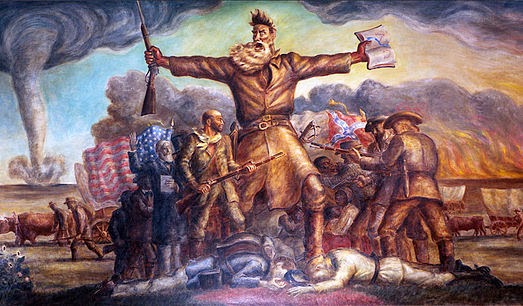
John Brown and the War against Slavery. the original is in the Kansas State House but a copy resides were John Brown made his finial stand, Harpers Ferry, WV.

When we teach it we should not omit it, not one part, because when we do we succumb to the dark ages once more. History will never be simple, never be easy, and that is because humans aren't. We have killed and suppressed each other, we have led with heavy hearts and yet we are still here. We are still learning and still growing and without telling the good, the bad, the ugly, and the useless dribble that can't continue. So yes America is amazing but we aren't perfect, and we still have aways to go and so does the rest of the world.

Tuesday, February 17, 2015

Purple Thang

At a sewing show I came across a magical tool for $5. I had seen it in quilt stores once or twice before and thought... "what a waste of money". I was wrong, so, so wrong. Here is the thing when it comes to life we are always looking for ways to make our lives easier. It is why we have everything in our lives. Now this tool I have used to fold seams, iron seams,  push difficult cloth through my machines foot and feed dogs, pull elastic through the band and a few other tasks. A simple tool but it works and I don't have to worry that I might accidentally melt it with the iron.

Tuesday, February 10, 2015

Baker gonna bake

So last summer I learned how to bake bread. I even got an assistant baker job at my day job. This resulted with me spending the next two months practicing in my tiny oven in my apartment on my one good  counter space. I used one recipe just to practice the main kneading method we would be using in the bakery called folding. it called for a dutch oven to bake it in. I called my mom and she had a dark glass one I could use.

Unfortunately it broke a few weeks ago. I did briefly think about buying a new one but while home for Christmas I used my moms baking stone. This helped me decided I would rather have a baking stone. After I did some research I bought a 15" pizza stone from Hartstone. Not only was it made in the USA but also under $30 so my wallet also did a happy dance.
No knead bread just coming out of the oven.

Now I have used it a couple of times and I am in love. Now all bread used to be made in brick/stone ovens, sometimes called beehive ovens. They would typically be in a dome shape with b a small opening in the front. A fire would be set inside for an hour or more heating the oven. Once the ashes are cleaned out the operator (baker, baker's assistant,  housewife) would stick their hand in. For me 5 to 8 seconds is about 450° to 500° Fahrenheit which is what most bread recipes call for. If I can hold my hand in that long it is good to go. Now this method goes back as far as risen loaves.

Bread going into a stone oven. The woman is using a peal to insert the bread. 14th century


The idea of a baking stone, which a lot of people use for pizza, goes back to that idea. The dutch oven is supposed to give it the seal an original stone oven would but the stone helps with even out the heat. It also has shortened my cooking time down from 30 to 40 minutes to 15 to 20.

3 century B.C. Roman mosaic Note the pipe in the back, most likely the baker keeps a small fire going in the back or on the side while he is baking.

So here's to the old ways and fresh bread.


Recipe used: No Knead bread from motherearthnews.com

Tuesday, February 3, 2015

Making mistakes. ..

I'll let you in on a secret, we all make mistakes.  Alright it isn't that big of a secret but it is a true one. Yet we as a society demand and expect perfection.  There is something that I was told though when it comes to making anything. It is never a mistake but rather a personalization.

This skirt was supposed to be white linen until I put it on and found it see-threw. So I fond this mesh fabric and put it on top. Not what I had planed but it worked our better.
You may think I am pulling your leg but I am not. Here's the thing I have cabled front when it should have been to the back. I have sewn sleeves on backwards, put buttons in the wrong spot and purled when I should have knit. I have even run out of fabric and yarn. Now sometimes I will go back and correct them, sometimes I am lazy and don't, sometimes I repeat the mistake creating it's own design and sometimes I just make it work. Sometimes I don't realize what I did until I am wearing the garment. This is usually when I realize I swapped the sleeves, made the collar too big,  or I forgot that the yarn I used stretched worse than a Stretch Armstrong with no chance of it returning to normal.

The sweater that stretched like stretch arm strong. I have to modify it once a year as it out grows me.

It is these garments however that I get the best complements for. I have a skirt that has a pieced together waist band because I ran out of cloth. I have one sweater that is a tad too tight on my upper arms yet I always get asked where I got it. Another one is way too big, I have been asked by several different people if I can make them one like it. (The answer is no,  I knit about 1 sweater a year, each taking me about 2 to 4 months.)

So this was a Christmas gift for my aunt. I finished the Celtic knot only to run out of yarn.  So using some left over black yarn from my brother's hat I made the top intermingling what little of the original yarn I had left.
The thing is other people don't notice that you made a mistake. They think it is done on purpose if they even notice something off. I have sold and know people who have sold items with these personal touches. So the next time you mistakenly run out of cloth or yarn don't go straight to the store and but more. Start by saving your scraps and then using them when you find yourself in these sort of situations. In the bigger picture you've made it yours and no one will know the difference in the end or you won't even notice where it happened.  Not all mistakes need fixing.

So this is a wedding veil I have been working on.  One of the loops has five picots instead of four. In the end no one will notice which one.


Tuesday, January 27, 2015

Snowed In

You know that song in White Christmas, Snow. It is one of my favorite scenes in my favorite Christmas movie. If you haven't seen it, Bing Crosby,  Danny Kaye, Rosemary Clooney and Vera-Ellen are all sitting on the train to Vermont excited for snow. They start singing about the fluffy white stuff. Well that is how I feel about the stuff. I love it, ok I don't like shoveling and really who does, but I love the look of it. There are snowman and snowballs to make. I love sledding down a big hill and then ice skating on an open lake. I enjoy going snowmobiling through the fresh powder and snow shoeing in the woods. There is nothing like it. When done you go inside, warming your bones by the fire and drink hot chocolate.

Pieter Bruegel the younger 1601


Now through history there has been ice and snow, after all there is an entire age called the Ice Age.  My family hails from Northern Europe so we have been dealing with the snow and cold for centuries. We like the cold and while not everyone does we almost thrive on it. Here is the thing many act like it is something new but for centuries we do the same with snow storms. First you batten down the hatches. Stock up on necessary needs. Farmers will tie ropes between the house and barn to make it easier to get from one to the other and safer. You stock up on wood, water, and food. In the past the stocking up of food started with the harvest. Than you sit by the fire and wait it out.  On occasion you might go out and shovel enough to get ahead of it if you can. Then you shovel yourself out and then you get to play in it.

Evening Skate - Charlotte Joan Sternberg

Since the invention of cars it had gotten easier to get out after I will admit but people still did, skis were created to help and snowshoes. Sleds for horses too. Ice skating too but sometimes more for fun. So enjoy the snow, make a snowman, or an angel. Then take you favorite mug and have some hot chocolate,  cider or tea, grab a good book or your latest project and enjoy being snowed in. Maybe I will finish knitting my next sweater in time for the next blizzard.

My dad, brother and I snowmobiling in NH.

Thursday, January 15, 2015

Spun from the distaff

Proverbs 31:19 - In her hands she holds a distaff and grasps the spindle with her fingers.

A depiction of Saint Gertrude of the 7th century using a spindle and a free standing distaff.


So I have very expensive hobbies, they seem inexpensive when you start, then you get into it and oops. You have $5,000 in materials. At first I thought spinning would be the cheapest. (Tatting is so far). But a five dollar spindle turned into a two hundred dollar spinning wheel and then my mom bought me the raw wool of an entire sheep. And I spent money on combs and card to process said sheep. Now I am on the hunt for a distaff for my wool but also so I can spin flax.


A Distaff is used mostly in flax spinning, and holds your fibers as you spin. They vary in shape and size depending on the fiber, culture and spinners preferences and sit under the spinners arm, stand on the floor or attach to the spinning wheel itself. I have even seen paintings of them attached to the walls. The purpose is to help keep the fibers from knotting and to hold your fiber as to free another hand. Most useful in flax spinning because the fibers can be very long, but also you need one hand free to wet the fibers as you spin. This gives you a softer, finer and more polished linen. Of course you can do it without wetting the fibers but you get a rough material.

A woman with an attached distaff, and two examples of hand held ones. Note the different positions.

To dress a distaff you flatten out the material and wrap it around the distaff. One wrapped you tie a ribbon or string around it to hold it in place. Wool can be placed in or on the distaff. Wool distaffs appear to be more pronged or hook shaped where flax distaffs are more rounded or squared better for wrapping. As for how long they have been in use, since they are mentioned in the bible and helpful in spinning probably nearly as old as spinning.

1. A distaff in a rounded shape.
2. A Puritan girl multitasking like a pro.
3. Women spinning flax by wetting it with their mouth.

So off I go in search of a distaff or maybe I will make one. Maybe not an adventure but at least it is useful.

Queen Victoria spinning, your argument that it is a hipsters hobby is invalid. 

Wednesday, January 7, 2015

Second sock syndrome

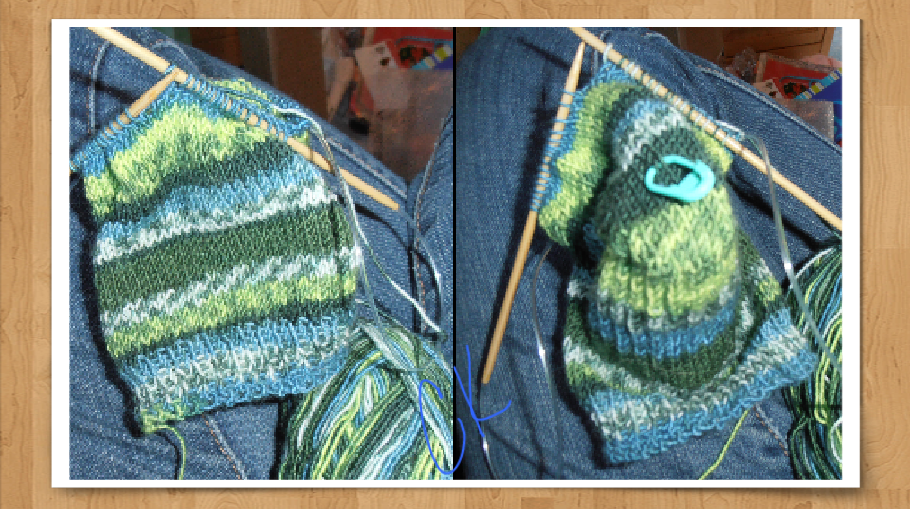
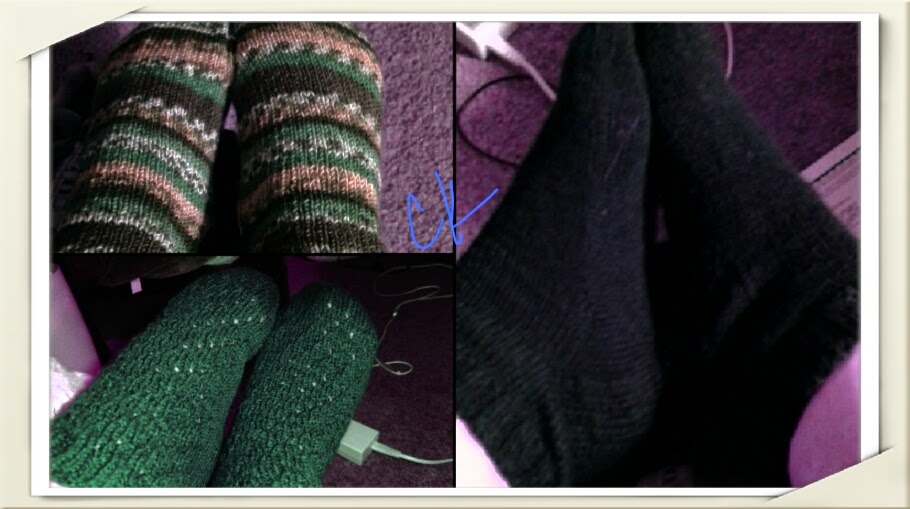
There is an illness among crafters. It is the unending pile of unfinished projects.  These symptoms of the disease can be caused by a difficult pattern or project, boredom, and life. We hide them too, all to forget about our defeat. All artists in this right are left forever working on their PhDs (Projects half done). For sock makers we call this disease Second Sock Syndrome.  You see when making socks, or mittens there is a trick the project plays on your mind. You finish one and you go yippy, finished, next project. Then you look at your feet and you think evil words. This happens after a very tedious pattern.  When I started knitting socks 3 years ago, I made myself a promise, I shall not suffer from second sock syndrome.


It isn't that socks are tricky. Once you figure out the math, designing and altering patterns is easier then other knitting projects. In fact the last 14 pairs of socks I made were patterns I designed. I actually find them my knitting candy. They fit perfectly in my purse so I can knit during my lunch break at work, on the train, at the doctors, and you get the idea. Sweaters, blankets,  some hats, and (once you get past a point) scarves don't fit in your purse as nice.


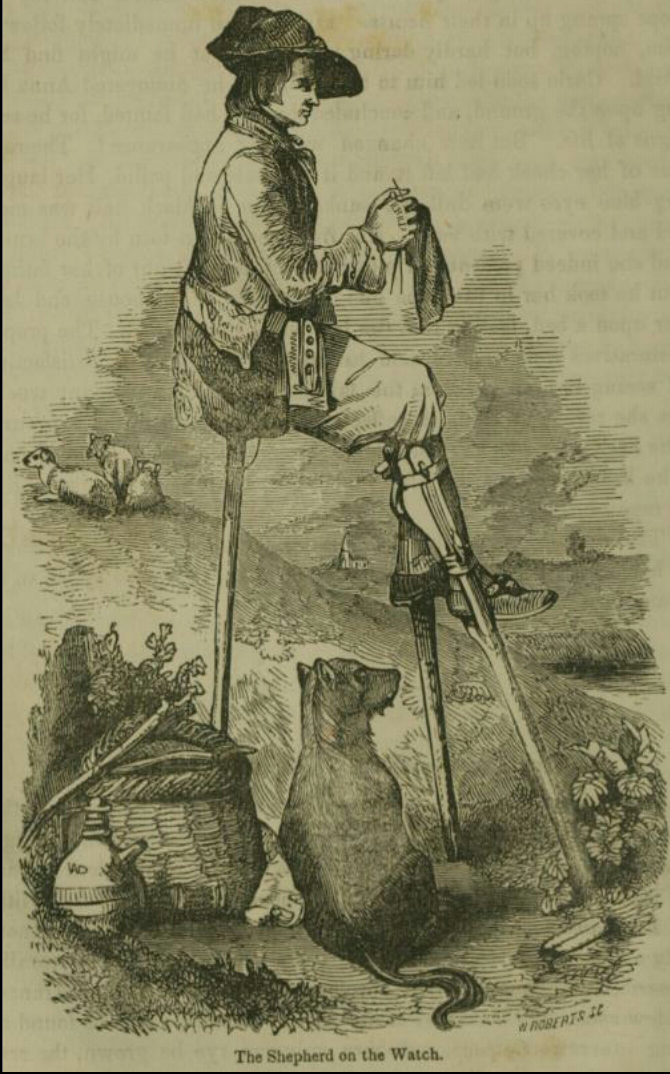
Today you can knit anything but at one point socks, hats, mittens and sweaters were the most common knitted items. They are also the most documented. We still find unfinished projects on the needles. Of the finished garments found the oldest item is believed to be socks. Who made them, we may never know. You see  knitting is a strange art, it has been seen as something only women do in the last two hundred years (that is changing again, as more men knit including Ryan Gossling, Christpher Walken and more). During times of war women were asked to knit socks for soldiers At that time of the American Civil War it was thought they made about ten socks a year. By the end of the war the average went up to three a week.  Before that it was seen as a task for the poor and mentality disabled. Fine lace knitting was a task for the weathy. At one time it was a man's trade in the cities. While in the country many could be found at the task from age five to ninty-five. Shepherds were even known to keep a knitting project at their side as they watch over the flock. I wonder if any of these people suffered from second sock syndrom or thier PhD.


So do you suffer from PhD syndrome? Was finishing them your New Years resolution? If so tell us what you are working on in the comments.


Tuesday, December 30, 2014

Let's drink a cup of kindness yet to days of Auld Lang Syne

Another year has come and gone as we made one more crazy, sometimes fantastic and sometimes sad trip around the sun. Never mind my personal life I have done so much this year. I officially kicked started my business, not selling much but enough to say I can do this. I started a blog. I apologize if it sometimes seems disorderly, and poorly written, I am working on it. That and my head is a bundle of over a thousand years of human history and fiber arts, and cooking, oh and song lyrics. Things are sometimes a bit muddled. So now I am going into the year of the sheep (I am taking that as a good sign for the year) and continuing to do what I love.


New Year is amazing. We set new goals for ourselves,  some we succeed in and some we don't.  By today's calendar we mark it as January 1st. The Chinese mark it this year on February 15, 2015 and as I said before this year will be the year of the sheep.


Even today depending on what calendar you look today is very different days. Today is December 30, 2014 by the Gregorian calender. Today we use the Julian Gregorian calender which sets the the first of the New Year as January 1st.  The earliest Gregorian calender set the first of the new year as March 25.

Viking calender was by the lunar months, a common occurrence across cultures.  Others were set by the seasons, often set the planting of the fields starting a new year. Some set more by the stars. While others were determined by what we today call the solstices, four in total. Winter solstice today lands on December 21st and in the northern hemisphere is the shortest day of the year. It is thought that the hedges found scattered throughout England, Wales, Scotland, Ireland and even a few in France were built by the Druids of the ancient Celts to help mark the summer and winter solstices.  The actual reason behind them is as big a mystery as the druids themselves.


So no matter what calender you go by have a Happy New Year. Here is to the hope it brings, the knowledge,  and best of all the friends who come with it.